
The iPad Air finds itself in a peculiar position today. It has the name, but somehow, somewhere down the line, it ceased to represent what that name stood for.
When Apple announced the original iPad Air in 2013, it was an obvious product launch. It was slimmer, lighter, and faster than its predecessor, the fourth-generation iPad it replaced. There was no subtlety about it either. Weighing in at 469 grams, it was trimmed down from the 652 grams of its predecessor. You could hold it in your hands and tell the difference. The name fit perfectly as it summed up what the device was all about. The iPad Air essentially existed in order to strip away everything unnecessary and reveal it for what it is: a magical piece of glass you can transform into whatever you like.
That clarity defined the Air for years. The iPad Air 2 went even further; at 6.1 millimeters, it became the thinnest iOS device Apple had ever made and reinforced the “Air” moniker as the simplest expression of Apple’s products. Each change served a central idea: reduce everything between you and the content and make the device disappear.
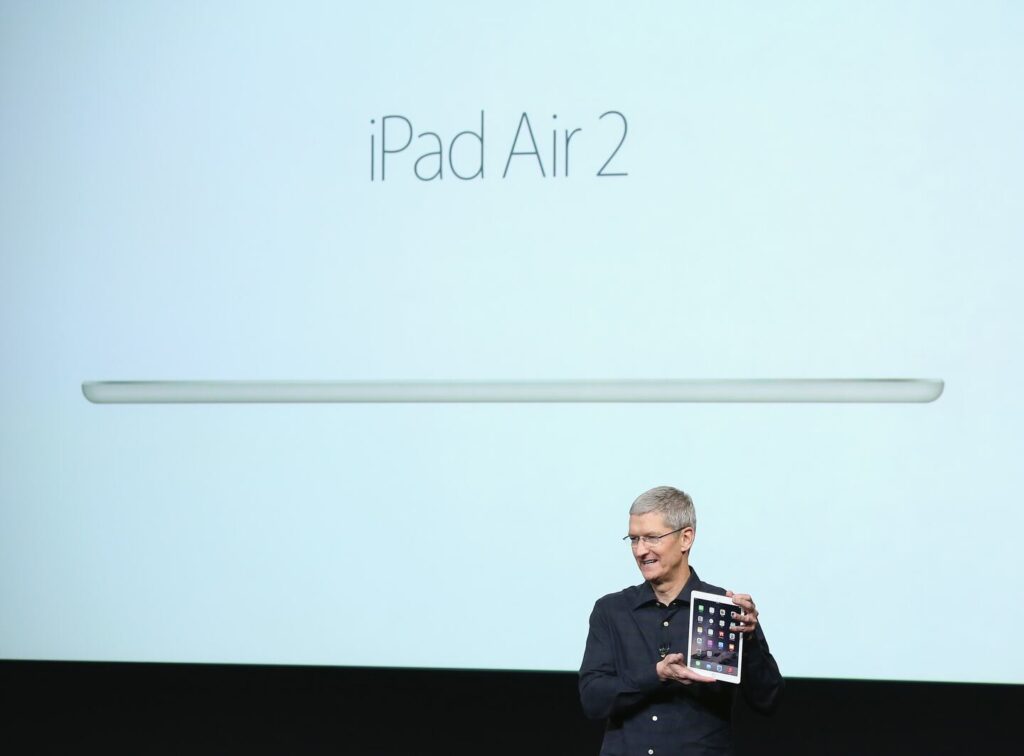
This clarity is no longer apparent. Today’s iPad Air is simply a price point. It sits between the entry-level 11th-gen iPad and the Pro models, filling a midfield position not because of what it is but because Apple wants something to occupy that price point. The design direction takes cues from its big sister. The specs are fine but not spectacular. The display is good but not great. There’s nothing about it now that’s designed to weigh lightly. Either physically or philosophically.
Zoom out and consider Apple’s other “Air” products and you will find a sore thumb. Take the MacBook Air, for instance. It still deserves the name. It is the thinnest and lightest notebook Apple makes, and Apple silicon reinforces that emphasis on efficiency. Since its 2022 redesign — and before it, really — the MacBook Air has stayed true to the Air name. It is the laptop you carry around without thinking about it. The name still describes what this product is.
Apple brought that same clarity to the iPhone. The iPhone Air is the thinnest iPhone the company has ever made, slotting between the standard iPhone and the Pro models. But the difference is intent. Apple shipped an iPhone Air because thinness defines the product, not because the company needed something at a certain price point. The name describes the experience.
The iPad Air doesn’t have that luxury. It sits in an odd spot in the lineup, neither the most accessible nor the most capable. It carries a name that once meant the purest expression of the iPad.
By comparison, the iPad Pro has become what Air used to promise: a tablet that justifies its own existence through restraint and refinement. The M4 and M5 models are astoundingly thin, lighter than many of the Airs that came before them. It’s a design that makes the device almost surreal to hold. The current iPad Pro is the dictionary definition of a magic sheet of glass that can change into whatever you need it to be.

On paper, of course, the Pro has more power, much better OLED displays, ProMotion, and better speakers. But those additions do not make it feel heavy or complicated. The Air, meanwhile, carries compromises it cannot justify. The screen is laminated, but it lacks the fluidity of ProMotion. The design is clean, but it is derivative. This is an Air because it is what you get when you remove things from the Pro, not because it is somehow based on a set of Air ideals.
The iPad Air is no longer an idea. The iPad Air is now a margin. It exists for customers who need more than the entry-level iPad offers but are unwilling to pay the iPad Pro premium. That is a reasonable business decision, but it is not a design decision. The Air has become a product of positioning rather than purpose.
The original iPad Air had purpose. It was the iPad that most people should buy because it delivered the core experience without asking you to compromise or overspend. It was Apple’s answer to the question: What does the iPad need to be? That answer was and should still be: lighter, quicker, and designed with purpose.
The iPad Pro, however, now provides a better answer to that question. It is the most direct manifestation of what an iPad could and should be when Apple puts all of its design and technological muscle behind it. The Air, in trying to be accommodating, has ended up being generic.
Apple understands this tension. The company has never been afraid of product lines overlapping when it serves a greater strategy. The MacBook Air and MacBook Pro coexisted for years in blurry distinction. But the MacBook Air can hold its identity with more conviction because it has remained true to portability and efficiency. The iPhone Air now carries that same conviction. The iPad Air has drifted.
The answer might lie in eliminating the Air. Not the product itself, but the name. Apple could consolidate its lineup by making its existing iPad Air just the iPad and discontinuing its low-end model altogether. The lineup would then look like this: iPad, iPad Pro, and iPad mini. Easy, straightforward, and honest about what each product is.
It is what happens to the Pro that is problematic. Unless there’s enough product in the pipeline for Apple to consider renaming the iPad Pro to the iPad Air, this kind of naming convention causes some awkwardness. The iPhone Air leads one to wonder if Apple’s plans for Air products might change, taking the Air moniker as an indication that said products will be slender and refined, but no longer necessarily mid-range. If that’s the case, perhaps the iPad Pro’s fate might be to become the iPad Air, and a more advanced iPad Pro model introduced above it. One must have a plan, and the plan isn’t yet clear here.
What is clear is that something has to change in the iPad Air lineup. The current system should not be allowed to work. The Air does not deserve its name, nor does it deserve its position in its lineup. Apple has two choices: it can re-identify what Air is to it, or it can be honest in saying that the iPad Air has no function other than filling a hole in its product lineup.
Until that happens, the iPad Pro will continue to feel more like an Air than the Air itself. It will be the device that feels unburdened, that disappears in use, that makes you forget you are holding a literal computer. The Air will remain what it is now: a capable iPad that exists because Apple needed something in the middle.
That is not what the name once meant. And it is not what it should mean now.