
Apple is set to spend roughly $1 billion a year on a customized 1.2 trillion-parameter version of Gemini, which will run Siri’s new architecture on Apple’s private servers, according to a report this week from Bloomberg. The model will support “Linwood,” the codename for the updated version of Siri that Craig Federighi and John Giannandrea are spearheading, and is anticipated to launch with iOS 26.4 this spring.
Technically speaking, this is a huge increase in model size. The current cloud version of Apple’s model has about 150 billion parameters, whereas the new one will have almost an order of magnitude more. This follows what Bloomberg called an “extensive evaluation period,” during which Apple tested Gemini, Claude, and ChatGPT from Google, Anthropic, and OpenAI.
For all the philosophical framing, Apple’s choice of Gemini over Claude or ChatGPT was likely driven by practicality. Android already has Gemini as a contextual assistant, which is a system that can understand device data and perform actions while taking the user’s context into consideration.
This is more in line with Apple’s goal of developing the Apple Intelligence platform, which is a private, customized AI layer operating at the OS level as opposed to an “Apple chatbot” bolted to the side. Though more composed, Anthropic’s Claude lacks the extensive OS-level integration Apple needs, and OpenAI’s ChatGPT is still conversationally limited. Simply put, Apple’s plans for Siri are well-suited for Gemini, which is already tuned for cross-app reasoning and hybrid on-device/cloud execution.
The main point of contention with Siri over the past year is the ability for the assistant to access a user’s personal data on their device, understand the content and context of that data semantically, and then use that information to answer questions and take actions. If you read the headlines, you’d think that this one Siri ability was the most important thing about Apple Intelligence, but it was only a five-minute segment of the more than two-hour WWDC 2024 keynote.
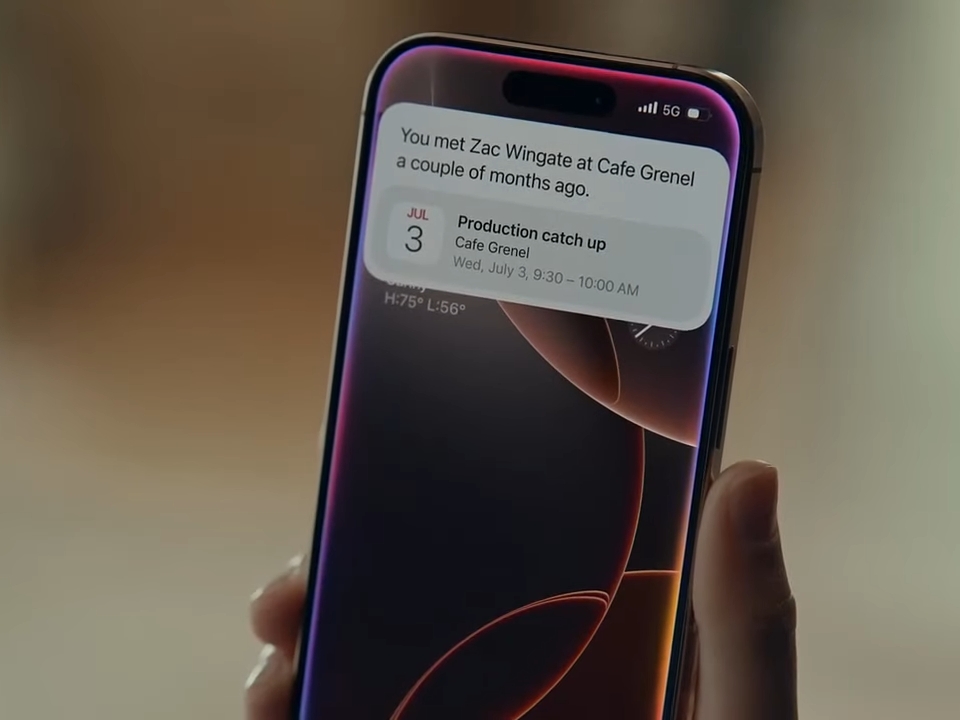
Apple showed us something, promised it for later that year, and then put it off because they were worried about quality. I’ve said it before: I’d rather Apple hold off than send out something that doesn’t meet its own standards just to say it’s caught up in AI. I’d also like to note here that Apple has refuted the post-WWDC narrative that the demos at WWDC 2024 were staged or nonfunctional. A working version of the new Siri architecture exists internally, and what was shown on stage in 2024 wasn’t vaporware.
That gap — between what Apple promised and what it could safely ship — is exactly what Gemini is designed to fill. With fierce rumors about how Apple would compare to other tech giants that have been releasing AI assistants, the company’s alleged “lag” in AI has taken center stage. The Gemini deal buys Apple time, not only to release a smarter Siri but also to rebuild the internal foundation behind it, at a time when internal teams are under pressure and key talent has been leaving.
Apple experimented with OpenAI integrations, held exploratory talks with Anthropic, and considered building its own model internally with a trillion parameters. Every course was risky. Investing in Anthropic would have required Apple to adopt its governance model and research culture, which it rarely does. An agreement with OpenAI would entail surrendering control over its own data. In the end, the Gemini partnership was the only one that appeared distinctly Apple-like: a temporary solution that facilitated control but accelerated schedules.
Importantly, this is not a public Gemini hosted on Google’s cloud. Apple plans for the model to operate independently, functioning solely within Apple’s Private Cloud Compute environment. For privacy-conscious users, that distinction will matter. Apple effectively manages the context, privacy, and interface, whereas Google provides the underlying computational strength.
Relying on a third-party solution isn’t an entirely new thing for Apple. It’s a pattern that runs deep in Apple’s history — from Maps to Silicon. Before Apple Maps, the original iPhone used Google Maps. Prior to Apple purchasing Dark Sky and bringing forecasting in-house, the Weather app used to license data from Yahoo and The Weather Channel. Each time, the company leaned on outside infrastructure. The same bridge is provided by Gemini, which allows one to learn quietly from within while maintaining competitiveness.
The decision speaks for itself. For the first time, if only briefly, Apple may soon be admitting that another company has created a better engine for the most innovative technology of the decade. But rather than weakening Apple’s position, that compromise clarifies it. Apple used the same long-term approach with Intel and Apple Silicon: rely on outside sources until its own technology can take over. Technology alone has never been Apple’s strength; rather, it’s how it transforms innovations into something accessible, elegant, and human.