
Update — August 8, 2026: This article began with a November 2025 Bloomberg report. Apple and Google later confirmed a multi-year collaboration, but neither company’s public statement confirmed the reported $1 billion annual price or a 1.2 trillion-parameter deployment. In June 2026, Apple disclosed a five-model Apple Foundation Models family custom-built with Google, spanning on-device models and Private Cloud Compute. Siri AI is now in developer testing, with a user beta planned for later in 2026.
In November 2025, Bloomberg reported that Apple planned to spend roughly $1 billion a year on a customized 1.2 trillion-parameter Gemini model for a new Siri architecture then codenamed “Linwood.” Apple and Google did not confirm those economics or that parameter count. What they confirmed on January 12, 2026 was a multi-year collaboration in which the next generation of Apple Foundation Models would be based on Google’s Gemini models and cloud technology. The leadership picture also changed: John Giannandrea moved toward retirement, while Amar Subramanya took core model work under Craig Federighi — part of Federighi’s expanded AI leadership.
At the time, the reported 1.2 trillion parameters sounded like a huge jump from the roughly 150 billion parameters attributed to Apple’s cloud model. Apple’s June 2026 technical disclosure describes a different public picture: a family of five models custom-built with Google, including a 3-billion-parameter on-device model, a sparse 20-billion-parameter on-device model, and three server models running on Private Cloud Compute. Apple has not publicly identified any one of those deployed models as the reported 1.2 trillion-parameter system, so that number should remain attributed to Bloomberg, not to Apple.
For all the philosophical framing, I read Apple’s choice as practical. The joint statement says Apple selected Google’s technology after “careful evaluation” because it provided the most capable foundation for Apple Foundation Models. That confirms Apple’s stated assessment; it does not establish that Android’s existing Gemini integration was the deciding factor.
The defensible comparison is architectural, not a blanket judgment about rival assistants. Apple wanted a model foundation it could integrate deeply into Apple Intelligence, Siri, and its operating systems while preserving its privacy boundary. Apple and Google say Gemini models and cloud technology form that foundation. Their public material does not support the claims that Claude inherently lacks the needed integration or that ChatGPT is conversationally limited, so I would not use those as factual reasons for the decision.
The main point of contention with Siri over the past year is the ability for the assistant to access a user’s personal data on their device, understand the content and context of that data semantically, and then use that information to answer questions and take actions. If you read the headlines, you’d think that this one Siri ability was the most important thing about Apple Intelligence, but it was only a five-minute segment of the more than two-hour WWDC 2024 keynote.
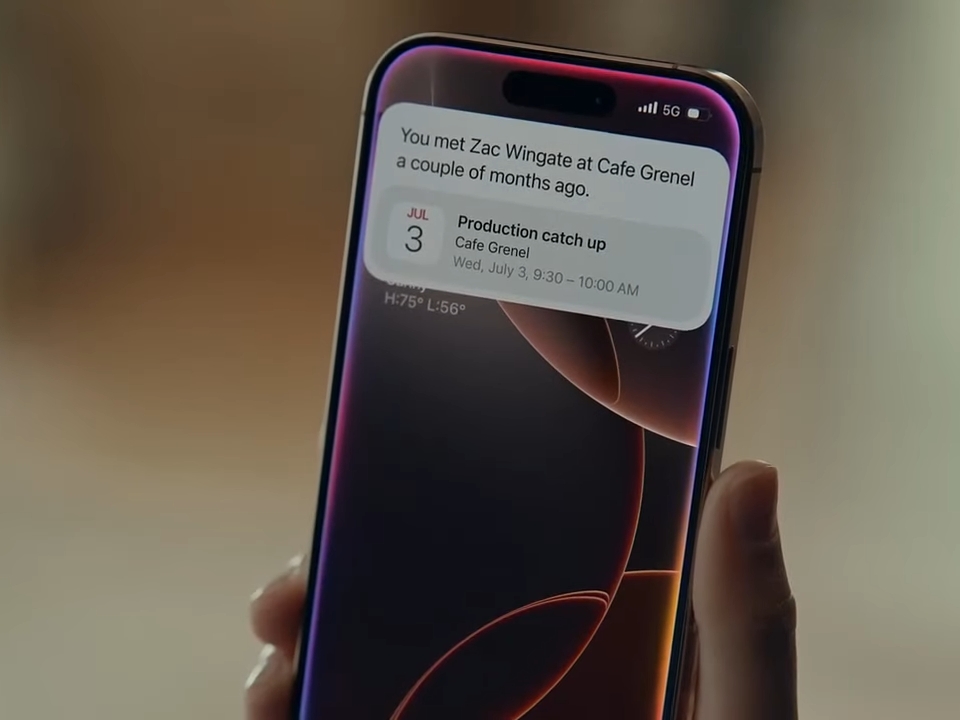
Apple showed the more personal Siri in 2024 and later delayed it. That delay is the historical gap this article was trying to explain. The status changed at WWDC26: Apple introduced the product it now calls Siri AI for developer testing and said a user beta would arrive later in 2026. That does not erase the missed timeline, but it means the assistant is no longer merely an internal architecture or an iOS 26.4 prediction. It also helps explain why execution, not spectacle, mattered at WWDC26.
The gap between what Apple promised and what it could safely ship is the strategic context for the Gemini collaboration. Apple and Google say the work will power future Apple Intelligence features, including Siri, and the agreement is explicitly multi-year. My view is that the collaboration also bought Apple time to rebuild its internal foundation, but neither company has described “buying time” as the purpose of the deal.
Reporting said Apple evaluated Gemini, Claude, ChatGPT, and larger internal models. The companies’ public statements confirm only that Apple carefully evaluated options and selected Google’s AI as the foundation for the next generation of Apple Foundation Models. They do not support the claims that an Anthropic agreement would have forced Apple to adopt Anthropic’s governance model or that an OpenAI agreement would have required Apple to surrender control of user data. Those scenarios should be treated as speculation, not the factual explanation for Apple’s choice.
Importantly, Apple is not describing Siri as a request sent to the public Gemini product. Apple says the new Apple Foundation Models run on device and on servers using Private Cloud Compute, where user data is not stored or made available to Apple or anyone else. The infrastructure is not solely Apple-owned hardware: for AFM 3 Cloud Pro, Apple says it worked with Google and NVIDIA to extend Private Cloud Compute to NVIDIA GPUs in Google Cloud while maintaining PCC’s privacy guarantees. Google supplies model and cloud technology; Apple defines the product integration and privacy architecture. That split is central to the shared intelligence layer I see across Apple’s platforms.
Relying on outside technology is not new for Apple; the original iPhone used Google Maps, and Macs used Intel processors before the Apple-silicon transition. That history makes a bridge interpretation tempting. But Apple and Google describe this agreement as a multi-year collaboration, and Apple says the resulting foundation models were custom-built with Google. The public record does not call the arrangement temporary or promise that Apple’s own model will replace it.
The decision still says something important: Apple publicly concluded that Google’s AI offered the most capable foundation for its next models. That compromise does not weaken the Apple part of the product. Apple’s strength has often been less about inventing every component than about turning technology into something accessible, elegant, and human. Whether Gemini is eventually replaced is unknown; what is confirmed today is a continuing collaboration, not a brief stopgap.