

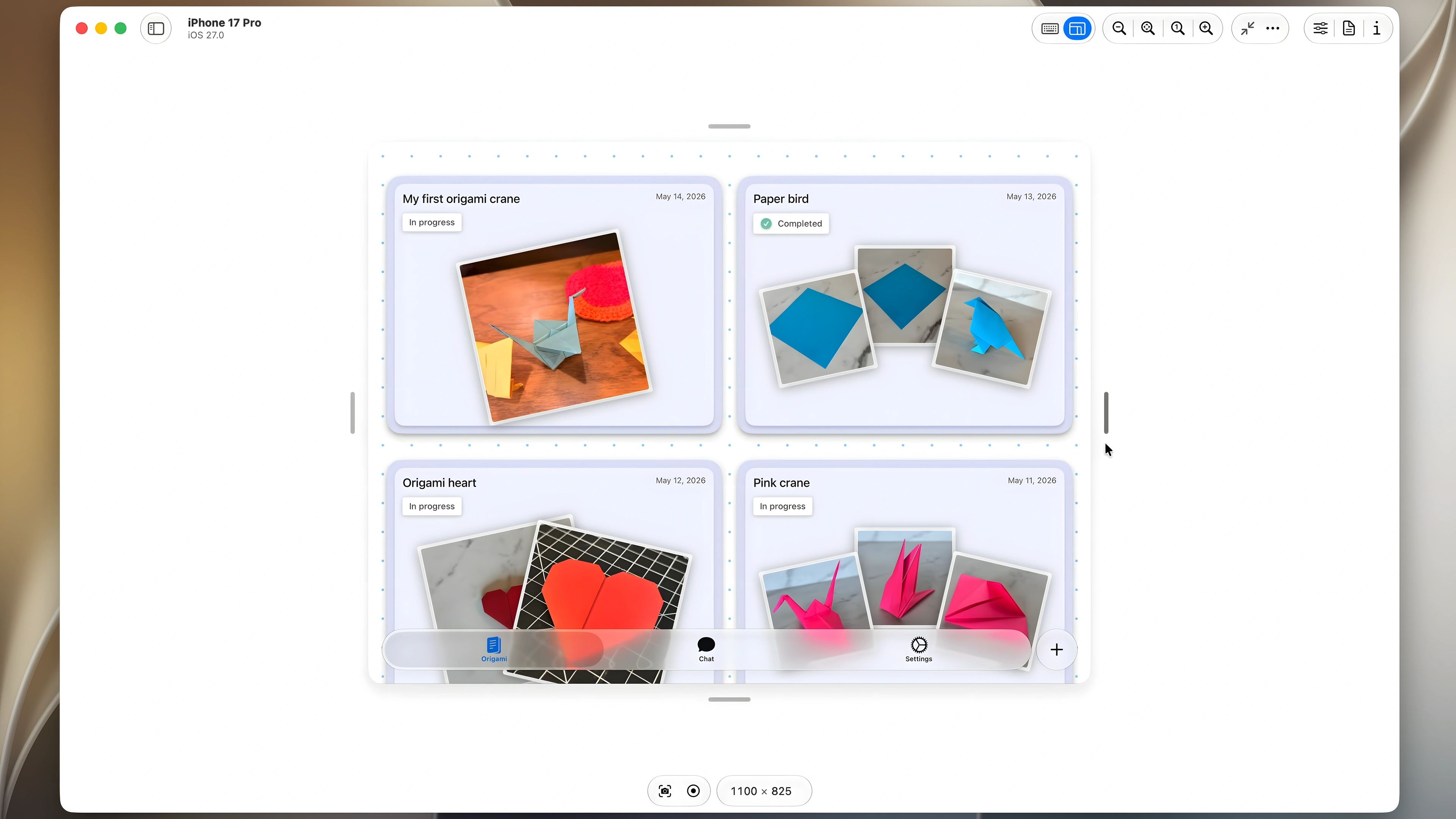
The sample app at this year’s Platform State of the Union was a place to relax. An origami app. A place, as Maribeth from the Foundation Models team put it, “to unwind and get creative with paper.” The demo involved generating paper craft projects from photos and producing step-by-step folding tutorials. The whole thing was warm and unhurried and thoroughly charming. I read it as a wink toward folding hardware, though Apple never said that was why it chose the demo.
The art of the fold.
At the same time, developer Sam Gold posted that he had found two terms in iOS 27 framework strings that he said were absent from iOS 26: foldState and angleDegrees. He also posted a system key that he described as returning the number of built-in displays. I have not independently reproduced those findings, and framework strings can support hardware or testing paths that never become a public product. If the observations are accurate, they are clues; they do not confirm a foldable iPhone.
The confirmed WWDC evidence is Apple’s resizability push. In the developer session “Modernize your UIKit app,” Apple said iPhone apps are fully resizable in iPhone Mirroring on Mac and when running on iPad. Xcode 27’s Device Hub and Previews also let developers test across screen sizes. That is a meaningful extension of the adaptivity work behind why iOS 27 renewed my excitement. The session does not mention or confirm a foldable iPhone.
Android foldables have already shown why adaptable layouts matter. My reading is that Apple would want developers prepared before it entered that category. Apple’s actual WWDC message was broader and clear: stop designing around one fixed screen and make iPhone apps adapt across the resizable environments Apple already supports. That work would help a foldable if one ships, but it is also useful on today’s iPad and Mac.
The hardware picture is much less certain. Third-party reports have described a book-style foldable iPhone, but Apple has not announced its name, dimensions, aspect ratio, price, production partner, production schedule, or launch date. Apple did confirm that John Ternus will become CEO on September 1, 2026. Neither that announcement nor Apple’s related leadership releases connect Ternus to a foldable launch or say he will present one. Apple’s wider leadership transition is real; the keynote scenario was my speculation.
The paper craft demo at the State of the Union ended with a tutorial: crease, fold, shape. There is something almost too neat about choosing it in the same week Apple pushed developers toward more adaptable interfaces. Apple shipped APIs and tools for resizable environments; it did not ship code that proves a foldable device is real. Those clues make the foldable theory plausible to me, and they fit the broader AppleOS 27 convergence I see. Smart play either way.